AWS North Community Conference 2026: The human side of the AI revolution



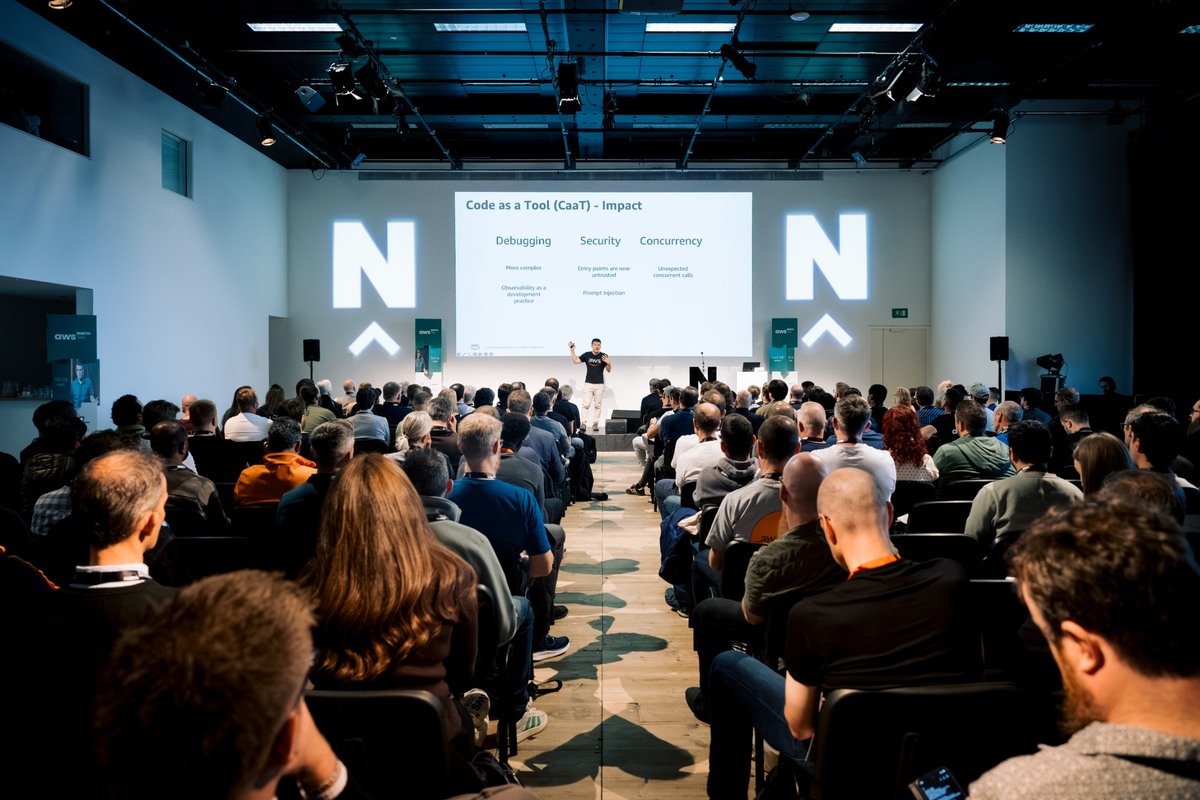
AI, agentic systems and the future of software engineering were firmly in the spotlight at this year’s AWS North Community Conference. But amid all the talk of intelligent agents and automated development, one message stood out – technology still needs people who know how to use it.
On Thursday 15th October, the North East’s technology community came together at The BALTIC in Gateshead for the second AWS North Community Conference. Bringing together developers, architects, technology leaders and innovators from across the AWS ecosystem, the event offered a packed day of ideas, practical insights and conversations about the future of cloud computing.
With four tracks to explore, there was plenty to get stuck into. AI was impossible to ignore, from the emergence of agentic architectures to new approaches to building production-ready software. However, alongside the technical possibilities, some important questions were raised. How do we manage the complexity that AI introduces? What does it mean for the role of an engineer? And how do we make sure that as our technology becomes more autonomous, people remain firmly in control?
These were questions that ran throughout the day, and they made for some fascinating discussions.
One of the things that makes AWS North special is its commitment to bringing the technology community together here in the North East. This year, powered by Leighton and supported by AWS, CGI, Scott Logic, TrueNorth and Northern Insight, the event once again demonstrated the strength of the wider ecosystem and showcased some of the organisations investing in its continued growth.
There’s no shortage of innovation happening in the region, and this year’s conference provided an opportunity for people to share what they’re learning, challenge established thinking and connect with others facing similar technical and business challenges. With four tracks offering different perspectives and plenty of opportunities to move between them, there was something for people at different stages of their careers and with different areas of expertise.
It was fitting that the opening keynote, delivered by Matheus Guimaraes, Senior Developer Advocate at AWS, tackled one of the biggest developments currently facing software engineers – the evolution of microservices in an agentic world.
In “Agentic Microservices: The Next Evolution of Microservices Architecture”, Guimaraes explored the similarities between microservices and AI agents. Both can be specialised, loosely coupled and composed into larger systems. But when agents begin interacting with services and with one another, familiar architectural assumptions start to change.
An agent might call a service repeatedly as it works towards a goal, with the number and timing of those requests becoming much less predictable than in a traditional application. That has implications for scalability, performance and cost, as well as for how services expose their capabilities to AI systems.
Serverless architecture featured prominently in the discussion, alongside emerging approaches such as making microservices available as tools to agents. But Guimaraes was clear that introducing an agent doesn't simply make an existing system more intelligent. It can introduce new challenges around security, concurrency, data consistency and observability. An apparently simple interaction can quickly become a complex chain of decisions and service calls, particularly when multiple agents begin collaborating as we’re seeing with agent swarms.
The takeaway was an important one; agentic systems need to be designed deliberately. Giving agents access to services is only the beginning; engineers also need to think carefully about the boundaries, permissions and controls that make those interactions safe and reliable.
If Guimaraes explored how our architectures are changing, Sheen Brisals, Strategic Lead Solution Architect and AWS Serverless Hero, challenged the audience to think about how engineers themselves need to evolve.
In “Are YOU an Agent?”, Brisals presented a thought-provoking look at the changing relationship between software engineers and AI. Through the story of two engineers whose careers take very different paths, he explored a question that many people in the industry are asking: Is AI making developers redundant, or is it creating opportunities for those willing to adapt?
His message was that programming and engineering are not the same thing. AI can generate code, automate tasks and accelerate implementation, but it cannot remove the need to understand the problem in the first place. That distinction matters more as the cost of producing code falls. The ability to write code remains useful, but the ability to understand a business, make sound architectural decisions and recognise the consequences of a solution becomes even more valuable.
Brisals encouraged engineers to look beyond their immediate responsibilities and embrace systems thinking, understanding how individual services fit into wider architectures, how those architectures support business domains, and how data moves through an organisation.
He also highlighted the importance of understanding data itself, from its origins and lifecycle to how it is stored, managed and interpreted. AI is only as useful as the information and context it receives, and retaining unnecessary data can introduce complexity rather than value. He mused that spending time developing skills in these areas will allow engineers to stop being AI passengers and get back to driving their projects.
The message was both challenging and encouraging. Engineers shouldn't see AI simply as a threat to their existing skills, but as an opportunity to develop new ones. Curiosity, critical thinking and engineering judgement will remain essential.
The practical realities of working with AI were also explored by Greg Farrow, Principal Cloud Engineer at Leighton, in “Beyond the Vibes: AI Agents Are Actually Awesome (If You Stop Treating Them Like Magic)”.
Farrow examined how AI agents can contribute to the software development lifecycle, while challenging the idea that simply asking an AI tool to build an application is enough to produce reliable, production-ready software.
The problem is often a lack of context. Without a clear understanding of requirements, architectural decisions, technical standards and the way a team works, an AI agent can produce inconsistent code that requires repeated prompting and significant rework. The solution is not necessarily a better prompt. It's better preparation.
Drawing on the AI-driven development lifecycle, Farrow explained the importance of making implicit and tacit knowledge explicit, documenting decisions and giving agents access to the right information when they need it. Skills, rules, tools and on-demand context retrieval can all help agents work more effectively without overwhelming them with unnecessary information.
A case study involving a personnel platform demonstrated what a more structured approach can achieve. With requirements, design and technical decisions established upfront, a project that would ordinarily have taken six weeks was completed in two weeks, with no compromises to code quality reported in the notes.
The important detail was that this wasn't about skipping the engineering process. Preparation accounted for a substantial part of the work, with four of the ten working days spent getting the foundations right.
It was a useful reminder that speed comes from structure, not shortcuts. AI can accelerate delivery, but it still needs the knowledge, constraints and judgement that experienced engineers bring to a project.
That idea of combining technological capability with human expertise was developed further in a session on AI-driven development and organisational change by Dave Anderson, Director of Architecture at G-P/Globalization Partners and Author of The Value Flywheel Effect, drawing on the Value Flywheel framework and his experience of modernising a complex global platform.
Anderson challenged the idea of a software factory, where success is measured primarily by how much code a team can produce. A better analogy, he suggested, is a software garden – a living system that needs to be designed, nurtured and continually maintained.
The distinction is important. Code is not the end product; it's a means of creating and evolving systems that deliver value. Even code written by an AI agent carries a responsibility to understand, maintain and improve it.
The session explored how a complex organisation operating across 180 countries approached modernisation through clear architectural principles, defined business domains and a platform built around reusable capabilities.
It also offered a glimpse of what happens when AI becomes part of the engineering process itself. Rather than treating an agent as a standalone coding assistant, the team developed an extensive collection of skills and agents to support different stages of work, from discovery and planning through to building and operating software.
The approach was deliberately collaborative. Engineers remained responsible for the work and the outputs, written context became a shared foundation, and human checkpoints were built into the process.
One specific example involved the launch of a product in a new country, a project that would normally have taken around six months but was completed in 16 days using this approach. The lesson wasn't that people had become unnecessary. It was that strong foundations, well-defined processes and experienced engineers can allow AI to help tackle complex work at a different pace.
While many conversations focused on making software development faster and more efficient, Jon Maskery, Cloud Transformation Lead at PwC, challenged delegates to think about a bigger opportunity – redesigning how businesses actually operate.
His session explored the difference between automating an existing process and rethinking the decisions that underpin it. Many AI programmes aim to make individual tasks quicker, but improving the speed of a task doesn't necessarily change the way an organisation works, nor does it guarantee a meaningful business outcome.
Maskery argued that the next wave of value will come from redesigning decision-making, accountability and operating models, rather than simply automating more activities.
Consider a production incident. An AI system might summarise logs and help an engineer understand what's happening. But deciding whether to roll back a production deployment is a different proposition, with potentially much greater consequences. The distinction highlights why organisations need to be clear about which decisions can be automated, which require human review and who remains accountable for the outcome.
The session explored an approach in which work is broken down into individual decisions, with appropriate levels of autonomy, governance and human oversight assigned to each. The level of control depends on factors such as impact, confidence and reversibility.
It's an important distinction for businesses considering agentic AI. Giving a system the ability to take action isn't the same as establishing when it should act, what it should be allowed to do and who is responsible if something goes wrong. Agentic transformation isn't about giving AI everything. It's about understanding what can move, under what conditions, and with the right controls in place.
Not every session was about transforming entire organisations. Some of the most useful insights came from engineers tackling everyday problems with thoughtful applications of cloud technology.
A great example was the session delivered by Jon Goodall, Principal Cloud Engineer at Logicata, which focused on on-call service provision using AI. On-call support can be an unavoidable part of running reliable services, but constant alerts and out-of-hours messages can leave engineers struggling to switch off. The challenge is to maintain visibility of genuine customer issues without waking people unnecessarily or allowing important messages to go unnoticed.
Goodall described how his team built a Slack bot to monitor customer channels, assess incoming messages and determine whether they needed attention outside working hours. The system considered factors such as the sender, the time of the message and whether someone had already responded. The aim was to reduce noise while retaining visibility of the things that mattered.
One observation from the session captured a recurring theme of the day, complexity cannot be destroyed; it can only be managed. Automating one part of a process often creates new requirements elsewhere, and those need to be understood and handled.
Crucially, the aim was never to remove people from the process altogether. It was to create a more sustainable balance between reliable customer support and the wellbeing of the engineers providing it.
Across four tracks and a packed day of talks, AWS North Community Conference 2026 explored the opportunities that AI and cloud technology are creating, alongside the challenges that come with them.
From agentic microservices and AI-assisted development to organisational transformation and resilient cloud operations, the sessions offered different perspectives on an industry moving through a period of significant change. But what connected them was a shared belief that technology alone isn't enough.
AI can help us write code faster, automate repetitive work and build systems capable of making decisions. Yet its value depends on the quality of the architecture around it, the context we provide, the data it uses and the people responsible for guiding it. The more capable our tools become, the more important it is to understand the problems we're trying to solve.
That is what made the day so valuable. It wasn't simply a showcase of new technologies or a celebration of what AI might make possible. It was an opportunity for the community to question assumptions, share practical experience and think critically about what comes next.
It was also another reminder of the strength of the North East's technology sector. Innovation doesn't belong to one city or postcode. It grows wherever talented people have the opportunity to learn, collaborate and build together. By bringing that community into one place at The BALTIC, AWS North once again demonstrated why it matters to invest in the region's people as well as its technology.
The tools will continue to change. The challenge and opportunity is to make sure we're ready to use them well.
AI, agentic systems and the future of software engineering were firmly in the spotlight at this year’s AWS North Community Conference. But amid all the talk of intelligent agents and automated development, one message stood out – technology still needs people who know how to use it.
On Thursday 15th October, the North East’s technology community came together at The BALTIC in Gateshead for the second AWS North Community Conference. Bringing together developers, architects, technology leaders and innovators from across the AWS ecosystem, the event offered a packed day of ideas, practical insights and conversations about the future of cloud computing.
With four tracks to explore, there was plenty to get stuck into. AI was impossible to ignore, from the emergence of agentic architectures to new approaches to building production-ready software. However, alongside the technical possibilities, some important questions were raised. How do we manage the complexity that AI introduces? What does it mean for the role of an engineer? And how do we make sure that as our technology becomes more autonomous, people remain firmly in control?
These were questions that ran throughout the day, and they made for some fascinating discussions.
One of the things that makes AWS North special is its commitment to bringing the technology community together here in the North East. This year, powered by Leighton and supported by AWS, CGI, Scott Logic, TrueNorth and Northern Insight, the event once again demonstrated the strength of the wider ecosystem and showcased some of the organisations investing in its continued growth.
There’s no shortage of innovation happening in the region, and this year’s conference provided an opportunity for people to share what they’re learning, challenge established thinking and connect with others facing similar technical and business challenges. With four tracks offering different perspectives and plenty of opportunities to move between them, there was something for people at different stages of their careers and with different areas of expertise.
It was fitting that the opening keynote, delivered by Matheus Guimaraes, Senior Developer Advocate at AWS, tackled one of the biggest developments currently facing software engineers – the evolution of microservices in an agentic world.
In “Agentic Microservices: The Next Evolution of Microservices Architecture”, Guimaraes explored the similarities between microservices and AI agents. Both can be specialised, loosely coupled and composed into larger systems. But when agents begin interacting with services and with one another, familiar architectural assumptions start to change.
An agent might call a service repeatedly as it works towards a goal, with the number and timing of those requests becoming much less predictable than in a traditional application. That has implications for scalability, performance and cost, as well as for how services expose their capabilities to AI systems.
Serverless architecture featured prominently in the discussion, alongside emerging approaches such as making microservices available as tools to agents. But Guimaraes was clear that introducing an agent doesn't simply make an existing system more intelligent. It can introduce new challenges around security, concurrency, data consistency and observability. An apparently simple interaction can quickly become a complex chain of decisions and service calls, particularly when multiple agents begin collaborating as we’re seeing with agent swarms.
The takeaway was an important one; agentic systems need to be designed deliberately. Giving agents access to services is only the beginning; engineers also need to think carefully about the boundaries, permissions and controls that make those interactions safe and reliable.
If Guimaraes explored how our architectures are changing, Sheen Brisals, Strategic Lead Solution Architect and AWS Serverless Hero, challenged the audience to think about how engineers themselves need to evolve.
In “Are YOU an Agent?”, Brisals presented a thought-provoking look at the changing relationship between software engineers and AI. Through the story of two engineers whose careers take very different paths, he explored a question that many people in the industry are asking: Is AI making developers redundant, or is it creating opportunities for those willing to adapt?
His message was that programming and engineering are not the same thing. AI can generate code, automate tasks and accelerate implementation, but it cannot remove the need to understand the problem in the first place. That distinction matters more as the cost of producing code falls. The ability to write code remains useful, but the ability to understand a business, make sound architectural decisions and recognise the consequences of a solution becomes even more valuable.
Brisals encouraged engineers to look beyond their immediate responsibilities and embrace systems thinking, understanding how individual services fit into wider architectures, how those architectures support business domains, and how data moves through an organisation.
He also highlighted the importance of understanding data itself, from its origins and lifecycle to how it is stored, managed and interpreted. AI is only as useful as the information and context it receives, and retaining unnecessary data can introduce complexity rather than value. He mused that spending time developing skills in these areas will allow engineers to stop being AI passengers and get back to driving their projects.
The message was both challenging and encouraging. Engineers shouldn't see AI simply as a threat to their existing skills, but as an opportunity to develop new ones. Curiosity, critical thinking and engineering judgement will remain essential.
The practical realities of working with AI were also explored by Greg Farrow, Principal Cloud Engineer at Leighton, in “Beyond the Vibes: AI Agents Are Actually Awesome (If You Stop Treating Them Like Magic)”.
Farrow examined how AI agents can contribute to the software development lifecycle, while challenging the idea that simply asking an AI tool to build an application is enough to produce reliable, production-ready software.
The problem is often a lack of context. Without a clear understanding of requirements, architectural decisions, technical standards and the way a team works, an AI agent can produce inconsistent code that requires repeated prompting and significant rework. The solution is not necessarily a better prompt. It's better preparation.
Drawing on the AI-driven development lifecycle, Farrow explained the importance of making implicit and tacit knowledge explicit, documenting decisions and giving agents access to the right information when they need it. Skills, rules, tools and on-demand context retrieval can all help agents work more effectively without overwhelming them with unnecessary information.
A case study involving a personnel platform demonstrated what a more structured approach can achieve. With requirements, design and technical decisions established upfront, a project that would ordinarily have taken six weeks was completed in two weeks, with no compromises to code quality reported in the notes.
The important detail was that this wasn't about skipping the engineering process. Preparation accounted for a substantial part of the work, with four of the ten working days spent getting the foundations right.
It was a useful reminder that speed comes from structure, not shortcuts. AI can accelerate delivery, but it still needs the knowledge, constraints and judgement that experienced engineers bring to a project.
That idea of combining technological capability with human expertise was developed further in a session on AI-driven development and organisational change by Dave Anderson, Director of Architecture at G-P/Globalization Partners and Author of The Value Flywheel Effect, drawing on the Value Flywheel framework and his experience of modernising a complex global platform.
Anderson challenged the idea of a software factory, where success is measured primarily by how much code a team can produce. A better analogy, he suggested, is a software garden – a living system that needs to be designed, nurtured and continually maintained.
The distinction is important. Code is not the end product; it's a means of creating and evolving systems that deliver value. Even code written by an AI agent carries a responsibility to understand, maintain and improve it.
The session explored how a complex organisation operating across 180 countries approached modernisation through clear architectural principles, defined business domains and a platform built around reusable capabilities.
It also offered a glimpse of what happens when AI becomes part of the engineering process itself. Rather than treating an agent as a standalone coding assistant, the team developed an extensive collection of skills and agents to support different stages of work, from discovery and planning through to building and operating software.
The approach was deliberately collaborative. Engineers remained responsible for the work and the outputs, written context became a shared foundation, and human checkpoints were built into the process.
One specific example involved the launch of a product in a new country, a project that would normally have taken around six months but was completed in 16 days using this approach. The lesson wasn't that people had become unnecessary. It was that strong foundations, well-defined processes and experienced engineers can allow AI to help tackle complex work at a different pace.
While many conversations focused on making software development faster and more efficient, Jon Maskery, Cloud Transformation Lead at PwC, challenged delegates to think about a bigger opportunity – redesigning how businesses actually operate.
His session explored the difference between automating an existing process and rethinking the decisions that underpin it. Many AI programmes aim to make individual tasks quicker, but improving the speed of a task doesn't necessarily change the way an organisation works, nor does it guarantee a meaningful business outcome.
Maskery argued that the next wave of value will come from redesigning decision-making, accountability and operating models, rather than simply automating more activities.
Consider a production incident. An AI system might summarise logs and help an engineer understand what's happening. But deciding whether to roll back a production deployment is a different proposition, with potentially much greater consequences. The distinction highlights why organisations need to be clear about which decisions can be automated, which require human review and who remains accountable for the outcome.
The session explored an approach in which work is broken down into individual decisions, with appropriate levels of autonomy, governance and human oversight assigned to each. The level of control depends on factors such as impact, confidence and reversibility.
It's an important distinction for businesses considering agentic AI. Giving a system the ability to take action isn't the same as establishing when it should act, what it should be allowed to do and who is responsible if something goes wrong. Agentic transformation isn't about giving AI everything. It's about understanding what can move, under what conditions, and with the right controls in place.
Not every session was about transforming entire organisations. Some of the most useful insights came from engineers tackling everyday problems with thoughtful applications of cloud technology.
A great example was the session delivered by Jon Goodall, Principal Cloud Engineer at Logicata, which focused on on-call service provision using AI. On-call support can be an unavoidable part of running reliable services, but constant alerts and out-of-hours messages can leave engineers struggling to switch off. The challenge is to maintain visibility of genuine customer issues without waking people unnecessarily or allowing important messages to go unnoticed.
Goodall described how his team built a Slack bot to monitor customer channels, assess incoming messages and determine whether they needed attention outside working hours. The system considered factors such as the sender, the time of the message and whether someone had already responded. The aim was to reduce noise while retaining visibility of the things that mattered.
One observation from the session captured a recurring theme of the day, complexity cannot be destroyed; it can only be managed. Automating one part of a process often creates new requirements elsewhere, and those need to be understood and handled.
Crucially, the aim was never to remove people from the process altogether. It was to create a more sustainable balance between reliable customer support and the wellbeing of the engineers providing it.
Across four tracks and a packed day of talks, AWS North Community Conference 2026 explored the opportunities that AI and cloud technology are creating, alongside the challenges that come with them.
From agentic microservices and AI-assisted development to organisational transformation and resilient cloud operations, the sessions offered different perspectives on an industry moving through a period of significant change. But what connected them was a shared belief that technology alone isn't enough.
AI can help us write code faster, automate repetitive work and build systems capable of making decisions. Yet its value depends on the quality of the architecture around it, the context we provide, the data it uses and the people responsible for guiding it. The more capable our tools become, the more important it is to understand the problems we're trying to solve.
That is what made the day so valuable. It wasn't simply a showcase of new technologies or a celebration of what AI might make possible. It was an opportunity for the community to question assumptions, share practical experience and think critically about what comes next.
It was also another reminder of the strength of the North East's technology sector. Innovation doesn't belong to one city or postcode. It grows wherever talented people have the opportunity to learn, collaborate and build together. By bringing that community into one place at The BALTIC, AWS North once again demonstrated why it matters to invest in the region's people as well as its technology.
The tools will continue to change. The challenge and opportunity is to make sure we're ready to use them well.