What the TravelTech Show 2026 told us about the state of AI in travel
.webp)


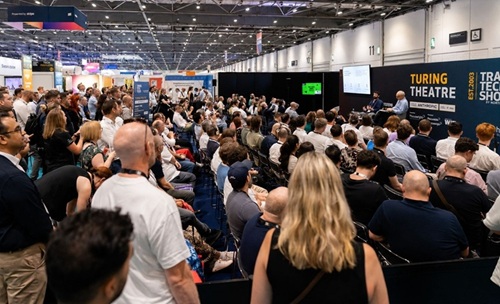
Last week we spent two days at the TravelTech Show in London, an event co-located with The Meetings Show and the Business Travel Show Europe, bringing together travel technology leaders, operators, and product builders under one roof at the Excel.
The scale of the industry context was set from the very first session. Show producer and travel tech writer Mark Frary opened with a reminder of just how much ground the industry has covered: in 2003, there were 694 million international tourist departures globally. That number is expected to reach 2.3 billion in 2026, the same year travel is forecast to contribute $12 trillion to the global economy. With 922 buyers in the room and an estimated half a billion pounds of tech spend expected to flow from meetings made at or because of the show, TravelTech Show remains a significant moment in the European travel tech calendar.
The agenda this year had a clear focus: AI, agentic commerce, payments, customer experience, distribution, and data quality. Here are the themes that stood out across the two days.
2023 was chatbots answering questions. 2024-25 was copilots drafting and summarising. Today, agents plan, execute, check their own work, and hand back finished outcomes, operating across your systems without constant human input.
If there was one message repeated across the two days, it was this: the conversation has moved on from chatbots and copilots to fully agentic AI and the gap between where businesses are and where the technology is heading is widening fast.
Anthropic's Enterprise GTM Lead Harry Herbert laid out the progression clearly: 2023 was chatbots answering questions. 2024-25 was copilots drafting and summarising. Today, agents plan, execute, check their own work, and hand back finished outcomes, operating across your systems without constant human input.
A separate session, ‘Getting Your Travel Business Ready for Agentic Commerce’ pushed this further, exploring what it looks like when the entire trip journey, from discovery through to booking and payment, happens inside a single conversational interface, with AI agents acting on the traveller's behalf.
For travel businesses, this isn't a future-looking exercise. The question being asked on the floor was not whether agentic AI is coming, but whether your systems, data, and commercial rules are ready for it.
It's not about having an AI product on your roadmap. It means having structured content, working connectors, and clear commercial data rules that an AI agent can actually navigate and transact with.
Becoming "agent-ready" came up repeatedly as a practical goal and it means something specific. It's not about having an AI product on your roadmap. It means having structured content, working connectors, and clear commercial data rules that an AI agent can actually navigate and transact with.
This connects directly to a session from Vervotech Founder & CEO Sanjay Ghare, whose talk ‘The Invisible Layer: Why Your Travel Business Lives or Dies on Data You Can't See’ made the case that the data layer is now the single biggest determinant of competitive advantage for OTAs, tour operators, and travel management companies operating at scale.
Production beats proof of concept. Real systems with real guardrails are where value is realised. Too many organisations are still at the POC stage and the gap between a successful pilot and a production-grade system is largely a data and architecture problem, not an AI problem.
This theme came up independently across multiple sessions, and it deserves emphasis. Multiple speakers pointed to the same pattern. Organisations rush toward AI capability before their data foundation is ready. POCs collapse not because the AI couldn't do the job, but because the data it was given to work with was a mess.
The practical implication is that before travel businesses ask: "what AI should we build?", they need to ask: "what does our data infrastructure actually look like, and can an agent navigate it?"
The most common reason AI projects in travel fail is not weak technology or poor strategy. It's unstructured, unmapped, inconsistent data underneath the agentic layer.
Phocuswright's research, presented by MD Pete Comeau, put some numbers behind what many in the room intuitively knew. Around 35-40% of European travellers are using AI in some form to plan trips, and the majority say AI has influenced a trip decision. But willingness to let AI go all the way through to booking sits at 27-32% and only a tiny fraction arewilling to give it full autonomy.
The trust ceiling is not a temporary problem to be overcome with better UX. It reflects something genuine about how high-consideration, high-cost purchases work. You only take 2-3 leisure trips a year. You really don't want to get it wrong.
Roopak Pati from Oppenheimer extended this into the luxury segment: with trillions in generational wealth being transferred over the coming decades, and younger travellers increasingly prioritising experiences over possessions, luxury and multi-generational travel is growing and it's the segment where human trust and relationship matter most. The consensus was that AI is a long way from replacing the high-end travel agent relationship.
Across the traveller experience sessions, the "AI vs. human" framing was largely dismissed. The real question, speaker after speaker argued, is about the quality of the transition between the two.
Lelde Douglass from Tui and Fredrik Axell from Nexer Unified Commerce both made versions of the same point. Customers want friction-free tech for the routine and the easy, and real humans for the complex, the emotional, and especially for when things go wrong. The ideal tech, as one panellist put it, is the tech you don't even perceive.
Tui's investment in crisis communication features was a good illustration, building not for the perfect journey, but for the moments when the journey breaks down. Customers want to feel informed and cared for when disruption hits, and that confidence ultimately comes from knowing a human is accountable.
The practical design challenge this sets for travel businesses: how do you engineer handoffs that feel seamless, rather than jarring? That's a product and systems problem as much as it is a customer experience one.
One of the more candid moments of the show came from Anthropic's Harry Herbert, who acknowledged that Anthropic's ability to have 98% of its own code written by AI is partly a function of being a start-up with no legacy systems to work around. For established travel businesses, the reality is very different.
Most travel operators are not starting from a clean slate. They have complex, layered codebases built over years, often across multiple acquired systems. Finding where agents can do the heavy lifting (and where humans still need to be in the loop) requires a real understanding of your existing architecture, not a vendor-led assumption that AI can simply be layered on top.
This is the conversation that doesn't get enough airtime at events like this, where the agenda naturally gravitates toward what's possible rather than what's in the way.
The social commerce panel surfaced some useful nuance for travel marketers. TikTok and Instagram are now genuine discovery and intent-building platforms, particularly for younger travellers, but the purchase cycle for travel is fundamentally different from fashion or beauty. Higher price points, longer consideration windows, and a much higher trust bar mean that "inspiration to booking" is rarely a straight line.
The brands doing this well are leaning into micro-creators with niche, highly engaged audiences rather than chasing reach. Kolsquare's research found that 92% of travel brands now work with micro and nano creators, partly because the authenticity and trust bar for travel is so high that niche credibility matters more than follower count.
The practical lesson: stop measuring influencer campaigns like PPC campaigns. The metric that matters is intent and enquiry, not last-click bookings.
Stepping back from any of the individual sessions, the narrative that emerged from the TravelTech Show 2026 is this...
The technology for agentic AI in travel is ready, or close to it. The constraint is not the AI. It's data foundations, legacy architecture, and the genuine trust dynamics of a high-consideration purchase category.
The travel businesses that will move fastest are not the ones with the most ambitious AI roadmaps. They're the ones who have done the harder, less exciting work. Getting their data in order. Understanding their codebase. Designing experiences that earn trust before they ask for autonomy.
That's not a technology problem. It's an engineering and product discipline problem. And it's where the real competitive advantage will be won.
The themes from TravelTech Show- AI's role in discovery and booking, the trust gap, the fragmented path to conversion - are exactly what we've been researching.
Our report, ‘From inspiration to conversion: AI-powered discovery and the modern travel retail journey’ explores how AI is disrupting the customer journey across discovery, planning and booking. It includes findings from exclusive independent research with 1,000 travellers, insights from CTOs at leading travel brands, and our own perspective on how to deploy AI for commercial impact including case studies to help you identify your own use cases.
Download the report here.

Last week we spent two days at the TravelTech Show in London, an event co-located with The Meetings Show and the Business Travel Show Europe, bringing together travel technology leaders, operators, and product builders under one roof at the Excel.
The scale of the industry context was set from the very first session. Show producer and travel tech writer Mark Frary opened with a reminder of just how much ground the industry has covered: in 2003, there were 694 million international tourist departures globally. That number is expected to reach 2.3 billion in 2026, the same year travel is forecast to contribute $12 trillion to the global economy. With 922 buyers in the room and an estimated half a billion pounds of tech spend expected to flow from meetings made at or because of the show, TravelTech Show remains a significant moment in the European travel tech calendar.
The agenda this year had a clear focus: AI, agentic commerce, payments, customer experience, distribution, and data quality. Here are the themes that stood out across the two days.
2023 was chatbots answering questions. 2024-25 was copilots drafting and summarising. Today, agents plan, execute, check their own work, and hand back finished outcomes, operating across your systems without constant human input.
If there was one message repeated across the two days, it was this: the conversation has moved on from chatbots and copilots to fully agentic AI and the gap between where businesses are and where the technology is heading is widening fast.
Anthropic's Enterprise GTM Lead Harry Herbert laid out the progression clearly: 2023 was chatbots answering questions. 2024-25 was copilots drafting and summarising. Today, agents plan, execute, check their own work, and hand back finished outcomes, operating across your systems without constant human input.
A separate session, ‘Getting Your Travel Business Ready for Agentic Commerce’ pushed this further, exploring what it looks like when the entire trip journey, from discovery through to booking and payment, happens inside a single conversational interface, with AI agents acting on the traveller's behalf.
For travel businesses, this isn't a future-looking exercise. The question being asked on the floor was not whether agentic AI is coming, but whether your systems, data, and commercial rules are ready for it.
It's not about having an AI product on your roadmap. It means having structured content, working connectors, and clear commercial data rules that an AI agent can actually navigate and transact with.
Becoming "agent-ready" came up repeatedly as a practical goal and it means something specific. It's not about having an AI product on your roadmap. It means having structured content, working connectors, and clear commercial data rules that an AI agent can actually navigate and transact with.
This connects directly to a session from Vervotech Founder & CEO Sanjay Ghare, whose talk ‘The Invisible Layer: Why Your Travel Business Lives or Dies on Data You Can't See’ made the case that the data layer is now the single biggest determinant of competitive advantage for OTAs, tour operators, and travel management companies operating at scale.
Production beats proof of concept. Real systems with real guardrails are where value is realised. Too many organisations are still at the POC stage and the gap between a successful pilot and a production-grade system is largely a data and architecture problem, not an AI problem.
This theme came up independently across multiple sessions, and it deserves emphasis. Multiple speakers pointed to the same pattern. Organisations rush toward AI capability before their data foundation is ready. POCs collapse not because the AI couldn't do the job, but because the data it was given to work with was a mess.
The practical implication is that before travel businesses ask: "what AI should we build?", they need to ask: "what does our data infrastructure actually look like, and can an agent navigate it?"
The most common reason AI projects in travel fail is not weak technology or poor strategy. It's unstructured, unmapped, inconsistent data underneath the agentic layer.
Phocuswright's research, presented by MD Pete Comeau, put some numbers behind what many in the room intuitively knew. Around 35-40% of European travellers are using AI in some form to plan trips, and the majority say AI has influenced a trip decision. But willingness to let AI go all the way through to booking sits at 27-32% and only a tiny fraction arewilling to give it full autonomy.
The trust ceiling is not a temporary problem to be overcome with better UX. It reflects something genuine about how high-consideration, high-cost purchases work. You only take 2-3 leisure trips a year. You really don't want to get it wrong.
Roopak Pati from Oppenheimer extended this into the luxury segment: with trillions in generational wealth being transferred over the coming decades, and younger travellers increasingly prioritising experiences over possessions, luxury and multi-generational travel is growing and it's the segment where human trust and relationship matter most. The consensus was that AI is a long way from replacing the high-end travel agent relationship.
Across the traveller experience sessions, the "AI vs. human" framing was largely dismissed. The real question, speaker after speaker argued, is about the quality of the transition between the two.
Lelde Douglass from Tui and Fredrik Axell from Nexer Unified Commerce both made versions of the same point. Customers want friction-free tech for the routine and the easy, and real humans for the complex, the emotional, and especially for when things go wrong. The ideal tech, as one panellist put it, is the tech you don't even perceive.
Tui's investment in crisis communication features was a good illustration, building not for the perfect journey, but for the moments when the journey breaks down. Customers want to feel informed and cared for when disruption hits, and that confidence ultimately comes from knowing a human is accountable.
The practical design challenge this sets for travel businesses: how do you engineer handoffs that feel seamless, rather than jarring? That's a product and systems problem as much as it is a customer experience one.
One of the more candid moments of the show came from Anthropic's Harry Herbert, who acknowledged that Anthropic's ability to have 98% of its own code written by AI is partly a function of being a start-up with no legacy systems to work around. For established travel businesses, the reality is very different.
Most travel operators are not starting from a clean slate. They have complex, layered codebases built over years, often across multiple acquired systems. Finding where agents can do the heavy lifting (and where humans still need to be in the loop) requires a real understanding of your existing architecture, not a vendor-led assumption that AI can simply be layered on top.
This is the conversation that doesn't get enough airtime at events like this, where the agenda naturally gravitates toward what's possible rather than what's in the way.
The social commerce panel surfaced some useful nuance for travel marketers. TikTok and Instagram are now genuine discovery and intent-building platforms, particularly for younger travellers, but the purchase cycle for travel is fundamentally different from fashion or beauty. Higher price points, longer consideration windows, and a much higher trust bar mean that "inspiration to booking" is rarely a straight line.
The brands doing this well are leaning into micro-creators with niche, highly engaged audiences rather than chasing reach. Kolsquare's research found that 92% of travel brands now work with micro and nano creators, partly because the authenticity and trust bar for travel is so high that niche credibility matters more than follower count.
The practical lesson: stop measuring influencer campaigns like PPC campaigns. The metric that matters is intent and enquiry, not last-click bookings.
Stepping back from any of the individual sessions, the narrative that emerged from the TravelTech Show 2026 is this...
The technology for agentic AI in travel is ready, or close to it. The constraint is not the AI. It's data foundations, legacy architecture, and the genuine trust dynamics of a high-consideration purchase category.
The travel businesses that will move fastest are not the ones with the most ambitious AI roadmaps. They're the ones who have done the harder, less exciting work. Getting their data in order. Understanding their codebase. Designing experiences that earn trust before they ask for autonomy.
That's not a technology problem. It's an engineering and product discipline problem. And it's where the real competitive advantage will be won.
The themes from TravelTech Show- AI's role in discovery and booking, the trust gap, the fragmented path to conversion - are exactly what we've been researching.
Our report, ‘From inspiration to conversion: AI-powered discovery and the modern travel retail journey’ explores how AI is disrupting the customer journey across discovery, planning and booking. It includes findings from exclusive independent research with 1,000 travellers, insights from CTOs at leading travel brands, and our own perspective on how to deploy AI for commercial impact including case studies to help you identify your own use cases.
Download the report here.
Last week we spent two days at the TravelTech Show in London, an event co-located with The Meetings Show and the Business Travel Show Europe, bringing together travel technology leaders, operators, and product builders under one roof at the Excel.
The scale of the industry context was set from the very first session. Show producer and travel tech writer Mark Frary opened with a reminder of just how much ground the industry has covered: in 2003, there were 694 million international tourist departures globally. That number is expected to reach 2.3 billion in 2026, the same year travel is forecast to contribute $12 trillion to the global economy. With 922 buyers in the room and an estimated half a billion pounds of tech spend expected to flow from meetings made at or because of the show, TravelTech Show remains a significant moment in the European travel tech calendar.
The agenda this year had a clear focus: AI, agentic commerce, payments, customer experience, distribution, and data quality. Here are the themes that stood out across the two days.
2023 was chatbots answering questions. 2024-25 was copilots drafting and summarising. Today, agents plan, execute, check their own work, and hand back finished outcomes, operating across your systems without constant human input.
If there was one message repeated across the two days, it was this: the conversation has moved on from chatbots and copilots to fully agentic AI and the gap between where businesses are and where the technology is heading is widening fast.
Anthropic's Enterprise GTM Lead Harry Herbert laid out the progression clearly: 2023 was chatbots answering questions. 2024-25 was copilots drafting and summarising. Today, agents plan, execute, check their own work, and hand back finished outcomes, operating across your systems without constant human input.
A separate session, ‘Getting Your Travel Business Ready for Agentic Commerce’ pushed this further, exploring what it looks like when the entire trip journey, from discovery through to booking and payment, happens inside a single conversational interface, with AI agents acting on the traveller's behalf.
For travel businesses, this isn't a future-looking exercise. The question being asked on the floor was not whether agentic AI is coming, but whether your systems, data, and commercial rules are ready for it.
It's not about having an AI product on your roadmap. It means having structured content, working connectors, and clear commercial data rules that an AI agent can actually navigate and transact with.
Becoming "agent-ready" came up repeatedly as a practical goal and it means something specific. It's not about having an AI product on your roadmap. It means having structured content, working connectors, and clear commercial data rules that an AI agent can actually navigate and transact with.
This connects directly to a session from Vervotech Founder & CEO Sanjay Ghare, whose talk ‘The Invisible Layer: Why Your Travel Business Lives or Dies on Data You Can't See’ made the case that the data layer is now the single biggest determinant of competitive advantage for OTAs, tour operators, and travel management companies operating at scale.
Production beats proof of concept. Real systems with real guardrails are where value is realised. Too many organisations are still at the POC stage and the gap between a successful pilot and a production-grade system is largely a data and architecture problem, not an AI problem.
This theme came up independently across multiple sessions, and it deserves emphasis. Multiple speakers pointed to the same pattern. Organisations rush toward AI capability before their data foundation is ready. POCs collapse not because the AI couldn't do the job, but because the data it was given to work with was a mess.
The practical implication is that before travel businesses ask: "what AI should we build?", they need to ask: "what does our data infrastructure actually look like, and can an agent navigate it?"
The most common reason AI projects in travel fail is not weak technology or poor strategy. It's unstructured, unmapped, inconsistent data underneath the agentic layer.
Phocuswright's research, presented by MD Pete Comeau, put some numbers behind what many in the room intuitively knew. Around 35-40% of European travellers are using AI in some form to plan trips, and the majority say AI has influenced a trip decision. But willingness to let AI go all the way through to booking sits at 27-32% and only a tiny fraction arewilling to give it full autonomy.
The trust ceiling is not a temporary problem to be overcome with better UX. It reflects something genuine about how high-consideration, high-cost purchases work. You only take 2-3 leisure trips a year. You really don't want to get it wrong.
Roopak Pati from Oppenheimer extended this into the luxury segment: with trillions in generational wealth being transferred over the coming decades, and younger travellers increasingly prioritising experiences over possessions, luxury and multi-generational travel is growing and it's the segment where human trust and relationship matter most. The consensus was that AI is a long way from replacing the high-end travel agent relationship.
Across the traveller experience sessions, the "AI vs. human" framing was largely dismissed. The real question, speaker after speaker argued, is about the quality of the transition between the two.
Lelde Douglass from Tui and Fredrik Axell from Nexer Unified Commerce both made versions of the same point. Customers want friction-free tech for the routine and the easy, and real humans for the complex, the emotional, and especially for when things go wrong. The ideal tech, as one panellist put it, is the tech you don't even perceive.
Tui's investment in crisis communication features was a good illustration, building not for the perfect journey, but for the moments when the journey breaks down. Customers want to feel informed and cared for when disruption hits, and that confidence ultimately comes from knowing a human is accountable.
The practical design challenge this sets for travel businesses: how do you engineer handoffs that feel seamless, rather than jarring? That's a product and systems problem as much as it is a customer experience one.
One of the more candid moments of the show came from Anthropic's Harry Herbert, who acknowledged that Anthropic's ability to have 98% of its own code written by AI is partly a function of being a start-up with no legacy systems to work around. For established travel businesses, the reality is very different.
Most travel operators are not starting from a clean slate. They have complex, layered codebases built over years, often across multiple acquired systems. Finding where agents can do the heavy lifting (and where humans still need to be in the loop) requires a real understanding of your existing architecture, not a vendor-led assumption that AI can simply be layered on top.
This is the conversation that doesn't get enough airtime at events like this, where the agenda naturally gravitates toward what's possible rather than what's in the way.
The social commerce panel surfaced some useful nuance for travel marketers. TikTok and Instagram are now genuine discovery and intent-building platforms, particularly for younger travellers, but the purchase cycle for travel is fundamentally different from fashion or beauty. Higher price points, longer consideration windows, and a much higher trust bar mean that "inspiration to booking" is rarely a straight line.
The brands doing this well are leaning into micro-creators with niche, highly engaged audiences rather than chasing reach. Kolsquare's research found that 92% of travel brands now work with micro and nano creators, partly because the authenticity and trust bar for travel is so high that niche credibility matters more than follower count.
The practical lesson: stop measuring influencer campaigns like PPC campaigns. The metric that matters is intent and enquiry, not last-click bookings.
Stepping back from any of the individual sessions, the narrative that emerged from the TravelTech Show 2026 is this...
The technology for agentic AI in travel is ready, or close to it. The constraint is not the AI. It's data foundations, legacy architecture, and the genuine trust dynamics of a high-consideration purchase category.
The travel businesses that will move fastest are not the ones with the most ambitious AI roadmaps. They're the ones who have done the harder, less exciting work. Getting their data in order. Understanding their codebase. Designing experiences that earn trust before they ask for autonomy.
That's not a technology problem. It's an engineering and product discipline problem. And it's where the real competitive advantage will be won.
The themes from TravelTech Show- AI's role in discovery and booking, the trust gap, the fragmented path to conversion - are exactly what we've been researching.
Our report, ‘From inspiration to conversion: AI-powered discovery and the modern travel retail journey’ explores how AI is disrupting the customer journey across discovery, planning and booking. It includes findings from exclusive independent research with 1,000 travellers, insights from CTOs at leading travel brands, and our own perspective on how to deploy AI for commercial impact including case studies to help you identify your own use cases.
Download the report here.
Last week we spent two days at the TravelTech Show in London, an event co-located with The Meetings Show and the Business Travel Show Europe, bringing together travel technology leaders, operators, and product builders under one roof at the Excel.
The scale of the industry context was set from the very first session. Show producer and travel tech writer Mark Frary opened with a reminder of just how much ground the industry has covered: in 2003, there were 694 million international tourist departures globally. That number is expected to reach 2.3 billion in 2026, the same year travel is forecast to contribute $12 trillion to the global economy. With 922 buyers in the room and an estimated half a billion pounds of tech spend expected to flow from meetings made at or because of the show, TravelTech Show remains a significant moment in the European travel tech calendar.
The agenda this year had a clear focus: AI, agentic commerce, payments, customer experience, distribution, and data quality. Here are the themes that stood out across the two days.
2023 was chatbots answering questions. 2024-25 was copilots drafting and summarising. Today, agents plan, execute, check their own work, and hand back finished outcomes, operating across your systems without constant human input.
If there was one message repeated across the two days, it was this: the conversation has moved on from chatbots and copilots to fully agentic AI and the gap between where businesses are and where the technology is heading is widening fast.
Anthropic's Enterprise GTM Lead Harry Herbert laid out the progression clearly: 2023 was chatbots answering questions. 2024-25 was copilots drafting and summarising. Today, agents plan, execute, check their own work, and hand back finished outcomes, operating across your systems without constant human input.
A separate session, ‘Getting Your Travel Business Ready for Agentic Commerce’ pushed this further, exploring what it looks like when the entire trip journey, from discovery through to booking and payment, happens inside a single conversational interface, with AI agents acting on the traveller's behalf.
For travel businesses, this isn't a future-looking exercise. The question being asked on the floor was not whether agentic AI is coming, but whether your systems, data, and commercial rules are ready for it.
It's not about having an AI product on your roadmap. It means having structured content, working connectors, and clear commercial data rules that an AI agent can actually navigate and transact with.
Becoming "agent-ready" came up repeatedly as a practical goal and it means something specific. It's not about having an AI product on your roadmap. It means having structured content, working connectors, and clear commercial data rules that an AI agent can actually navigate and transact with.
This connects directly to a session from Vervotech Founder & CEO Sanjay Ghare, whose talk ‘The Invisible Layer: Why Your Travel Business Lives or Dies on Data You Can't See’ made the case that the data layer is now the single biggest determinant of competitive advantage for OTAs, tour operators, and travel management companies operating at scale.
Production beats proof of concept. Real systems with real guardrails are where value is realised. Too many organisations are still at the POC stage and the gap between a successful pilot and a production-grade system is largely a data and architecture problem, not an AI problem.
This theme came up independently across multiple sessions, and it deserves emphasis. Multiple speakers pointed to the same pattern. Organisations rush toward AI capability before their data foundation is ready. POCs collapse not because the AI couldn't do the job, but because the data it was given to work with was a mess.
The practical implication is that before travel businesses ask: "what AI should we build?", they need to ask: "what does our data infrastructure actually look like, and can an agent navigate it?"
The most common reason AI projects in travel fail is not weak technology or poor strategy. It's unstructured, unmapped, inconsistent data underneath the agentic layer.
Phocuswright's research, presented by MD Pete Comeau, put some numbers behind what many in the room intuitively knew. Around 35-40% of European travellers are using AI in some form to plan trips, and the majority say AI has influenced a trip decision. But willingness to let AI go all the way through to booking sits at 27-32% and only a tiny fraction arewilling to give it full autonomy.
The trust ceiling is not a temporary problem to be overcome with better UX. It reflects something genuine about how high-consideration, high-cost purchases work. You only take 2-3 leisure trips a year. You really don't want to get it wrong.
Roopak Pati from Oppenheimer extended this into the luxury segment: with trillions in generational wealth being transferred over the coming decades, and younger travellers increasingly prioritising experiences over possessions, luxury and multi-generational travel is growing and it's the segment where human trust and relationship matter most. The consensus was that AI is a long way from replacing the high-end travel agent relationship.
Across the traveller experience sessions, the "AI vs. human" framing was largely dismissed. The real question, speaker after speaker argued, is about the quality of the transition between the two.
Lelde Douglass from Tui and Fredrik Axell from Nexer Unified Commerce both made versions of the same point. Customers want friction-free tech for the routine and the easy, and real humans for the complex, the emotional, and especially for when things go wrong. The ideal tech, as one panellist put it, is the tech you don't even perceive.
Tui's investment in crisis communication features was a good illustration, building not for the perfect journey, but for the moments when the journey breaks down. Customers want to feel informed and cared for when disruption hits, and that confidence ultimately comes from knowing a human is accountable.
The practical design challenge this sets for travel businesses: how do you engineer handoffs that feel seamless, rather than jarring? That's a product and systems problem as much as it is a customer experience one.
One of the more candid moments of the show came from Anthropic's Harry Herbert, who acknowledged that Anthropic's ability to have 98% of its own code written by AI is partly a function of being a start-up with no legacy systems to work around. For established travel businesses, the reality is very different.
Most travel operators are not starting from a clean slate. They have complex, layered codebases built over years, often across multiple acquired systems. Finding where agents can do the heavy lifting (and where humans still need to be in the loop) requires a real understanding of your existing architecture, not a vendor-led assumption that AI can simply be layered on top.
This is the conversation that doesn't get enough airtime at events like this, where the agenda naturally gravitates toward what's possible rather than what's in the way.
The social commerce panel surfaced some useful nuance for travel marketers. TikTok and Instagram are now genuine discovery and intent-building platforms, particularly for younger travellers, but the purchase cycle for travel is fundamentally different from fashion or beauty. Higher price points, longer consideration windows, and a much higher trust bar mean that "inspiration to booking" is rarely a straight line.
The brands doing this well are leaning into micro-creators with niche, highly engaged audiences rather than chasing reach. Kolsquare's research found that 92% of travel brands now work with micro and nano creators, partly because the authenticity and trust bar for travel is so high that niche credibility matters more than follower count.
The practical lesson: stop measuring influencer campaigns like PPC campaigns. The metric that matters is intent and enquiry, not last-click bookings.
Stepping back from any of the individual sessions, the narrative that emerged from the TravelTech Show 2026 is this...
The technology for agentic AI in travel is ready, or close to it. The constraint is not the AI. It's data foundations, legacy architecture, and the genuine trust dynamics of a high-consideration purchase category.
The travel businesses that will move fastest are not the ones with the most ambitious AI roadmaps. They're the ones who have done the harder, less exciting work. Getting their data in order. Understanding their codebase. Designing experiences that earn trust before they ask for autonomy.
That's not a technology problem. It's an engineering and product discipline problem. And it's where the real competitive advantage will be won.
The themes from TravelTech Show- AI's role in discovery and booking, the trust gap, the fragmented path to conversion - are exactly what we've been researching.
Our report, ‘From inspiration to conversion: AI-powered discovery and the modern travel retail journey’ explores how AI is disrupting the customer journey across discovery, planning and booking. It includes findings from exclusive independent research with 1,000 travellers, insights from CTOs at leading travel brands, and our own perspective on how to deploy AI for commercial impact including case studies to help you identify your own use cases.
Download the report here.